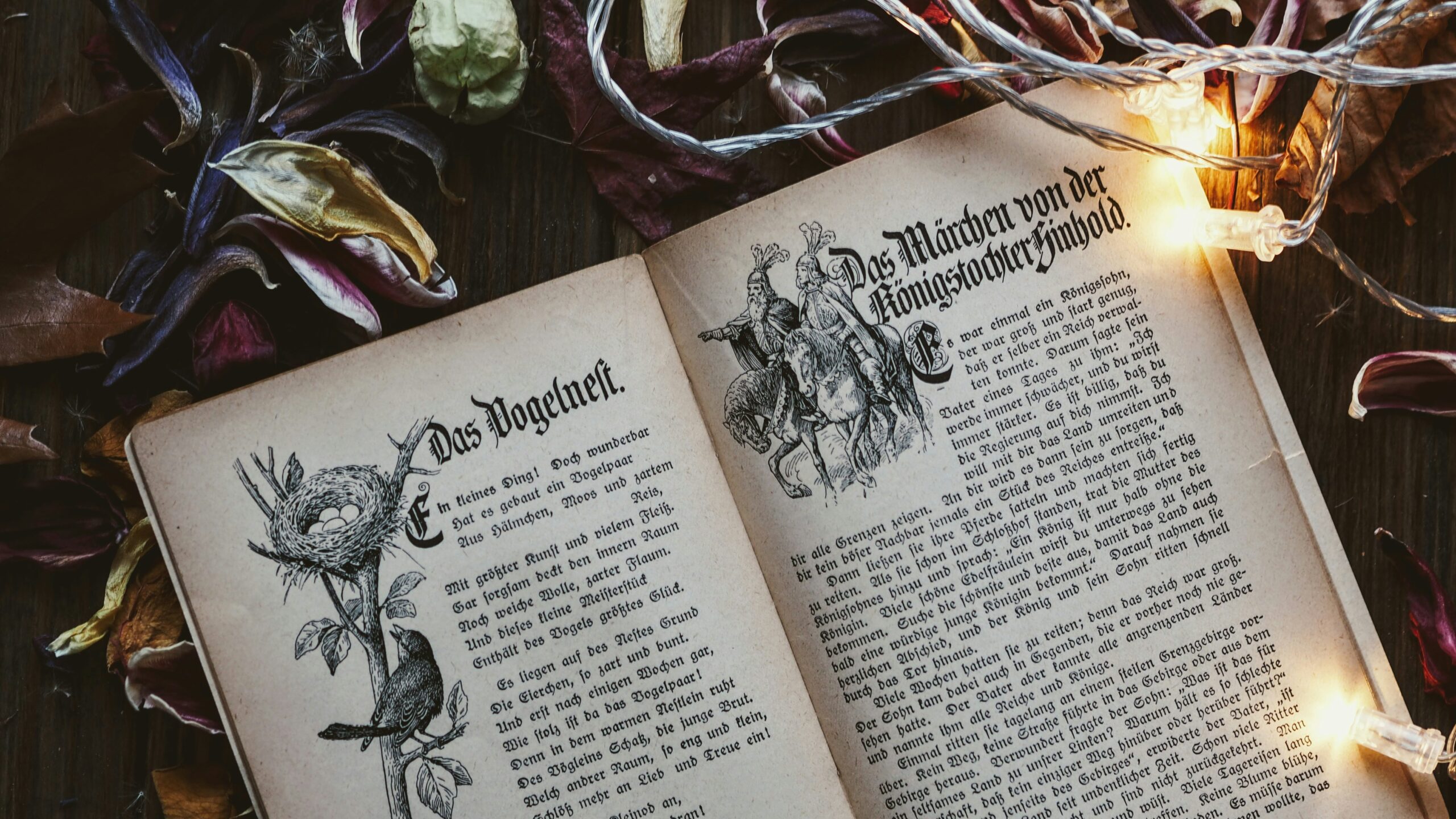
The Case for the Moral Imagination in Literature (Where it all began)
In the spring of 2021, I faced a daunting task: to establish and refine a research idea suitable for two majors and pitch it to a committee of individuals with differing perspectives, in order to secure grant funding for the research project.
Not your usual issue for a standard undergraduate degree.
The university I attended (which will remain nameless) was often instrumental in both challenging my stamina as a student and my diplomacy as a well-rounded, well-influenced individual. Thus, both were strategically in conflict as I met with my advisor (a woman I greatly admire, but with whom I also greatly disagree in many ways) and planned a project that I was neither convinced would work nor passionate about.
I marketed the idea on the philosophy of fairytales. More specifically, I initially planned to compare the components of fairytales – specifically their representation of women – across the board. I was speedily awarded the grant and the time to research, clarifying that this project would fulfill a degree in English Language and Literature and a standard history major as well.
That summer, I slaved away at my trusty and practically ancient laptop (the same one I used to write this article), summoning books from various libraries across the state, planning trips that fell through, and reading more scholarly literature than I’d ever planned. And through it all, my focus for the project (blessedly) evolved.
And it happened because I picked up an old favorite book of mine: The Lion, the Witch, and the Wardrobe.
A few years prior, I’d discovered a love for C.S. Lewis’s adult content, namely The Screwtape Letters and many others. However, The Chronicles of Narnia has remained a personal favorite of mine since my childhood. I remember oppressively locking my younger sister in our room and forcing her to listen to me read the books aloud because I was so passionate about both the whimsy and majesty of the series.
I rediscovered that delight over the summer as a senior undergraduate student about to engage in the most comprehensive research project of her life. And when I emerged at the start of classes, a totally new idea had formed.
The final paper was given a very ostentatious title (From Nursery to Narnia: Ideal Girlhood in Nineteenth-Century Children’s Literature and C.S. Lewis’s The Lion, the Witch, and the Wardrobe) and I was enormously proud of it. Far more proud than I would have been if I’d stuck with my original idea.
By the end of the spring semester in 2022, I submitted a paper that was nearly 86 pages long (bibliography included) and received the most prestigious award my college could offer in return. It seemed a fair trade at the time. But what I truly gained from the experience as an individual would turn out to be entirely more precious. For one, I couldn’t stop thinking of things to write about. This new sense of success had me second-guessing every essay topic, ready to research and debate. Even now, years later, I’m chomping at the bit to share and create. And maybe it’s that last action that really intrigues me.
To create.
This is quickly becoming a foreign concept in the modern age of generative AI, but the ability to craft and create is an innate human desire that will not fade. Lewis himself appealed to my senses so much because of his sense of creator-ship. Though not developed to the level and stamina of Tolkien’s The Lord of the Rings, he nonetheless created literature that fostered one of the most precious ideas I’ve come to recognize in only the best pieces of literature: the moral imagination.
The moral imagination, as defined by Britannica (a site I appreciate for mundane moments like these), is “the presumed mental capacity to create or use ideas, images, and metaphors not derived from moral principles or immediate observation to discern moral truths or to develop moral responses.” In short, the moral imagination refers to the idea that stories, literature, and the imagination of our own experiences can give us the language of morality and the difference between right and wrong.
For example, look at The Lion, the Witch, and the Wardrobe, the focus of my senior research paper. We, as readers, know that the lion, Aslan, represents something great and good, and the White Witch represents something corrupt and evil, though neither entity exists in real life. And through both, children are able to perceive the actions of both good and evil.
Every story is a lesson, many of which are hard to discover, and it was around this concept that all of my ideas centered. I thought to myself, “Perhaps you would be better off with a platform on which to continuously publish…” That alone brought me here, the starting point of what I hope to be a prolific writing career, whether anyone chooses to join me or not.
Aside from Chasing the Birds, however, the moral imagination reaches other corners of my life. After graduating with high honors, a prestigious award for my research project, and a desire to take my newfound knowledge into the publishing industry, I instead found myself journeying to the cold, wintry edges of the continent in search of greater meaning in life. In doing so, I discovered the depth of a faith I am still learning to nurture years later. When I returned home, my love for publishing had dimmed, and the desire to work a corporate job in some remote city all but died.
Teaching, it turns out, is an excellent way to explore the moral imagination in real time.
As an English teacher, reading novels, short stories, and essays with my students gives me an opportunity to not only explore my own understanding of morality in different genres but also to help foster a sense of wonder and imagination in this next generation. While my faith largely remains a taboo topic in the public school system, it is woven into every aspect of my instruction. There is good and evil in everything we read, in the history we analyze, in the lessons we learn.
Advocate for the moral imagination. We need it in school, in earlier levels, integrated into our curriculum. We need it as part of homeschool programs and resources. We need it in the technological age, where the lines of ethics become blurred with the usage of Artificial Intelligence. We need it as functioning adults, living in a society that tells us we don’t need our imagination.